

// Glossary
Acronyms and terms, defined.
A plain-language reference for the conditions, devices, and procedures discussed across this site. Linked from the For Patients & Families page so families can look up anything that comes up in clinic. Definitions stay short on purpose — if you want more depth, the linked pages go further.
A
- Anterior temporal lobectomy (ATL)
- An open operation for temporal lobe epilepsy. The surgeon removes the front part of the temporal lobe, along with the deep structures where many seizures begin. It is the oldest and best-studied of these operations. In carefully chosen patients it gives the best chance of stopping seizures for good.
- Awake craniotomy
- Brain surgery in which the patient is awake for part of the procedure, so the team can test brain function in real time. Used in deep brain stimulation (DBS), epilepsy mapping, and certain tumor surgeries near speech or motor areas.
B
- Basal ganglia
- A group of deep brain structures that help control voluntary movement, learning, and habit formation. Many movement disorders (Parkinson's, dystonia) involve abnormal basal-ganglia activity.
- BCI · Brain computer interface
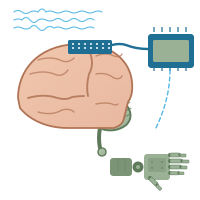
- A system that reads brain activity and turns it into control of something outside the body — a computer, a robotic arm, or a device that moves a person's own hand. It is being developed to give back movement and communication to people who have lost them.
- Burr-hole anchor
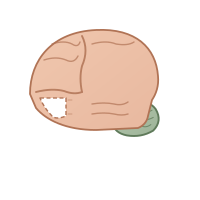
- A small ring-shaped device fixed into the skull where a DBS lead enters the brain. It holds the lead in place and lies under the scalp.
C
- CGRP-blocker
- A class of headache medications that target the calcitonin gene-related peptide pathway. Often tried before considering surgical options for chronic migraine.
- Chiari malformation
- A condition where the lower part of the brain (cerebellar tonsils) extends into the spinal canal, sometimes causing headache, balance problems, or cord compression. May need decompression surgery.
- Closed-loop stimulation
- A device that monitors brain or body signals and only delivers stimulation when something abnormal is detected. The opposite of "open-loop" stimulation, which runs on a fixed schedule.
- CRPS · Complex regional pain syndrome
- A burning, swelling, color-changing, hypersensitive pain condition in a hand, foot, or limb — often after an injury or surgery. Usually treated with a combination of physical therapy, medications, and (when refractory) DRG or spinal cord stimulation.
D
- DBS · Deep brain stimulation
- An operation in which a thin wire is placed in a particular deep part of the brain and joined to a small device under the skin of the chest, rather like a heart pacemaker. The device sends steady pulses along the wire. The settings can be adjusted in clinic afterwards, without further brain surgery.
- DBS-ANT
- Deep brain stimulation aimed at the front part of the thalamus, approved by the FDA in 2018 for focal epilepsy that medicines have not controlled. In the trial it was based on, seizures fell by about two-thirds after five years.
- DRG · Dorsal root ganglion
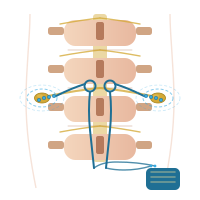
- A small bundle of nerve cells that sits just outside the spinal cord, one on each side at every level of the spine. These bundles carry pain signals from one specific part of the body. Placing a lead next to one lets us target pain in a small area — one foot, or the groin — without stimulating everything else.
- Dystonia
- A movement disorder marked by sustained or repetitive involuntary muscle contractions, causing twisting postures or repetitive movements. Can be focal (one area) or generalized (whole body). Treated with medications, botulinum toxin, and DBS.
E
- ECoG · Electrocorticography
- Recording electrical brain activity directly from the surface of the cortex (under the skull but not penetrating the brain). Used in epilepsy monitoring and BCI research. Sometimes called subdural EEG.
- EEG · Electroencephalography
- Recording brain activity with electrodes placed on the scalp. Used for epilepsy monitoring, sleep studies, and many other neurological evaluations.
- Engel class I
- A standard classification meaning a patient is essentially seizure-free after epilepsy surgery. Often the goal of resective surgery.
- Essential tremor (ET)
- A common movement disorder causing rhythmic shaking, usually of the hands during action (writing, holding a cup). Distinct from Parkinson's tremor (which happens at rest). Treatable with medications, DBS, MRgFUS, or Gamma Knife.
F
- FBSS · Failed back surgery syndrome
- Persistent back and/or leg pain after spine surgery. Now sometimes called "persistent post-surgical pain." A common indication for spinal cord stimulation.
- Focal seizure
- A seizure that starts in a specific part of the brain (as opposed to a generalized seizure that involves the whole brain at once). Most surgical candidates have focal seizures.
- FOG · Freezing of gait
- A symptom of advanced Parkinson's where patients feel as if their feet are "stuck to the floor" when starting to walk or turning. The MJFF-funded CnF DBS trial targets levodopa-resistant FOG.
- Fugl-Meyer (FMA-UE)
- A standardized scale for upper-extremity motor function after stroke. The primary outcome measure in the VNS-REHAB trial of paired VNS for chronic stroke.
G
- Gamma Knife
- A form of stereotactic radiosurgery that uses focused gamma-ray beams to treat a small target in the brain without an incision. Used for trigeminal neuralgia, brain metastases, AVMs, and some movement disorders.
- GPi · Globus pallidus internus
- A deep brain target for DBS in Parkinson's disease (helps with dyskinesia, rigidity, tremor) and dystonia.
H
- Hippocampal sclerosis
- Scarring and shrinkage of the hippocampus, the most common pathology underlying mesial temporal lobe epilepsy. Often treatable with anterior temporal lobectomy or laser ablation (SLAH).
- Hypothalamic hamartoma
- A rare benign growth of brain tissue in the hypothalamus that can cause seizures (especially gelastic seizures — laughing fits) and hormonal problems. LITT is often used to treat them.
I
- IPG · Implantable pulse generator
- The small battery-powered device, typically implanted in the chest or abdomen, that delivers stimulation through a lead. The "pacemaker" component of DBS, SCS, VNS, and similar systems.
- Intraoperative neurophysiology
- Recording brain or nerve activity during surgery, both to inform the surgical plan and to study how the brain works in awake humans.
- Intrathecal pump
- A small implanted pump that delivers pain or spasticity medication directly to the spinal fluid, achieving better control at much lower doses than oral or IV routes.
- Ischemic stroke
- A stroke caused by a blocked blood vessel in the brain (versus a hemorrhagic stroke, which is bleeding). The form of stroke for which paired VNS is FDA-approved as adjunct rehab.
L
- Lesionectomy
- An operation to remove one specific abnormal spot that is causing seizures. That might be a tumour, a patch of brain that formed abnormally before birth, or a knot of abnormal blood vessels. Only that spot is taken out.
- LITT · Laser interstitial thermal therapy
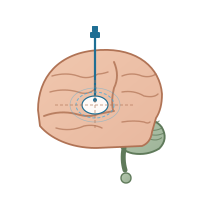
- A keyhole operation. A thin laser fibre is passed through a small opening in the skull to the exact spot causing the trouble, and gentle heat is used to switch that small piece of tissue off. The surgeon watches it happen on an MRI scan in real time. Most people go home after one or two nights.
M
- Microvascular decompression (MVD)
- An open surgery for trigeminal neuralgia that places a small cushion between the trigeminal nerve and the blood vessel pressing on it. Often the most durable treatment for classical TN.
- MRgFUS · MR-guided focused ultrasound
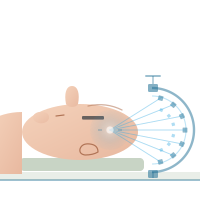
- A treatment with no cut and no implant. Sound waves are aimed through the skull so that they all meet at one small spot deep in the brain, and the heat where they meet switches that spot off. You lie awake in an MRI scanner while it is done, so the team can check the effect as they go. Most people go home the same evening.
N
- Neuromodulation
- Using electrical, magnetic, or chemical stimulation to alter the activity of nerves or brain circuits. Most of the lab's clinical work — DBS, SCS, DRG, VNS, RNS — falls under this umbrella.
- Neuroplasticity
- The brain's ability to rewire itself in response to experience, learning, or injury. Paired VNS for stroke recovery aims to enhance neuroplasticity during rehab.
O
- Occipital neuralgia
- Sharp, shooting pain at the back of the head, caused by irritation of the occipital nerves. Treated with nerve blocks, medications, and (if refractory) occipital nerve stimulation.
- ONS · Occipital nerve stimulation
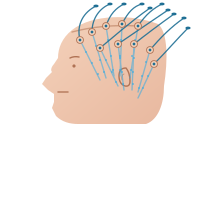
- A peripheral nerve stimulation system with leads placed under the skin at the back of the head over the occipital nerves. Used for refractory chronic migraine, cluster headache, and occipital neuralgia.
P
- Painful diabetic neuropathy (PDN)
- Burning or shooting nerve pain in the feet from long-standing diabetes. Spinal cord stimulation is FDA-approved for PDN that hasn't responded to medications.
- Paired VNS
- Vagus nerve stimulation given at the moment you succeed at a movement in therapy. Because the pulse arrives just as you move, the brain links the two together. The aim is to help the brain relearn the movement faster than therapy on its own.
- Paddle lead
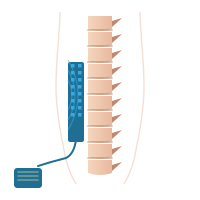
- A flat electrode array placed in the spinal epidural space for spinal cord stimulation. Provides more focused, durable stimulation than a percutaneous (needle-placed) lead but requires a small open surgery.
- Parkinson's disease (PD)
- A neurodegenerative movement disorder caused by loss of dopamine-producing brain cells. Symptoms include tremor at rest, stiffness, slowness, and balance problems. Treated with medications, DBS, MRgFUS, and supportive care.
- PNS · Peripheral nerve stimulation
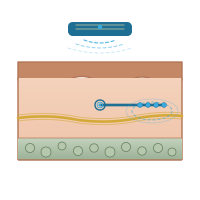
- A small implanted device that sends gentle electrical pulses to one particular nerve outside the brain and spinal cord — in the shoulder, knee, foot, or elsewhere. It is used when the pain follows a single nerve. Some systems stay in for good; others are designed to come out after about 60 days.
- Percutaneous
- "Through the skin" — a procedure done through a needle or small puncture rather than an open incision. Trigeminal neuralgia is sometimes treated with percutaneous procedures (glycerol rhizotomy, balloon compression, radiofrequency rhizotomy).
R
- Rhizotomy
- An interruption of a nerve root, typically used to relieve pain or spasticity. The trigeminal nerve can be partially interrupted percutaneously (glycerol, RF, balloon compression) for trigeminal neuralgia.
- RNS · Responsive neurostimulation
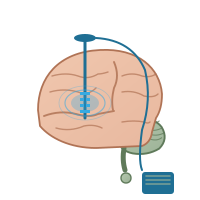
- A small device, made by NeuroPace, that sits in the skull with one or two wires reaching the spot where seizures start. It watches your brain activity all the time, and when it spots the pattern that comes before a seizure it sends a brief pulse you cannot feel. It is useful when seizures come from two places, from both sides, or from an area that cannot safely be removed.
S
- SAH · Selective amygdalohippocampectomy
- A smaller operation than removing the whole front of the temporal lobe. The surgeon takes out only the two deep structures where these seizures usually start — the amygdala and the hippocampus — and leaves the rest of the lobe alone. The aim is to stop the seizures while sparing more healthy tissue.
- SCS · Spinal cord stimulation
- A small implanted device that sends gentle electrical pulses to the spinal cord to ease long-standing pain. It is used most often for back and leg pain that continues after spine surgery, for complex regional pain syndrome, and for painful nerve damage from diabetes. You always try a temporary version first, to see whether it helps you.
- SEEG · Stereo-electroencephalography
- A way of finding exactly where seizures start. Thin recording wires are passed into the brain through small holes in the skull, and you stay in hospital for a few days while your seizures are recorded. It is a test, not a treatment — it tells the team what to do next.
- SLAH · Stereotactic laser amygdalohippocampotomy
- LITT used to ablate the amygdala and hippocampus in mesial temporal lobe epilepsy. Less invasive than open ATL with comparable seizure-free rates and better cognitive recovery.
- STN · Subthalamic nucleus
- A small deep-brain target for DBS in Parkinson's disease (helps with tremor, stiffness, slowness, and reduces medication needs).
T
- Thalamotomy
- An ablation in the thalamus (usually the VIM nucleus) to treat tremor. Can be done with MRgFUS, Gamma Knife, RF, or LITT.
- Thalamus
- A pair of deep brain structures that relay signals between the cortex and the rest of the brain. Several thalamic targets are used in DBS — VIM for tremor, ANT for epilepsy.
- Trigeminal neuralgia (TN)
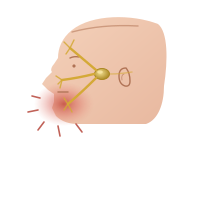
- Sudden, severe face pain that feels like an electric shock. It comes from irritation of the trigeminal nerve, the nerve that carries feeling from the face. Often a blood vessel is pressing on the nerve where it leaves the brainstem. Attacks can be set off by chewing, talking, brushing your teeth, or even a light breeze.
- Trigeminal nerve field stimulation
- A peripheral subcutaneous neuromodulation approach for refractory trigeminal pain. Reversible — no nerve tissue is destroyed.
V
- VIM · Ventral intermediate nucleus of the thalamus
- The classic DBS or thalamotomy target for essential tremor and tremor-dominant Parkinson's.
- VNS · Vagus nerve stimulation
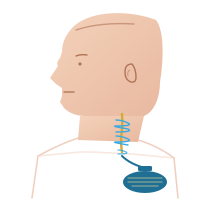
- A small device placed in the chest, with a thin wire that wraps around the vagus nerve in the left side of the neck. It sends regular pulses along that nerve. The FDA approved it in 1997 for epilepsy that medicines have not controlled, and in 2005 for depression. It is added on top of medicines, and the aim is fewer seizures rather than none at all.
- VTA · Volume of tissue activated
- The estimated 3D region of brain tissue around a DBS lead contact that is influenced by stimulation. Modeling the VTA helps with programming.