


Help push the work forward.
For former patients, families, and supporters who want to be part of the lab's effort to better understand the brain and spinal cord — and to bring meaningful options to people living with neurological injury and disease.
Give to the Neuro Interventional Research Fund.
The lab's named fund at Penn Medicine accepts gifts of any size. Philanthropic support directly enables work that doesn't yet have grant funding — pilot studies, recording equipment, trainee support, and the time it takes to translate findings into care.
The fastest way to support the lab financially is through Penn Medicine's giving site.
For larger gifts, named funds, planned giving, IRA qualified charitable distributions, or employer matching, see the major gifts and planned giving section below.
What gifts move forward.
The lab's research spans three clinical areas, each with active translational work that benefits directly from philanthropic support.
Movement disorders
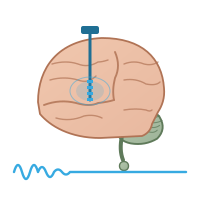
Intraoperative neurophysiology during awake deep brain stimulation (DBS) for Parkinson's disease and essential tremor. Imaging-guided directional DBS, focused ultrasound for tremor, and early work on cerebellar DBS for cerebral palsy. Gifts fund recording equipment, motion-capture instrumentation, and graduate trainee time.
Research →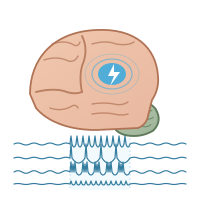
Epilepsy & neuromodulation
Stereo-EEG recordings to characterize seizure onset zones, including thalamic SEEG; quantitative biomarkers such as neural fragility; long-term outcomes of laser interstitial thermal therapy. Gifts support computational analysis, pilot studies, and graduate research.
Research →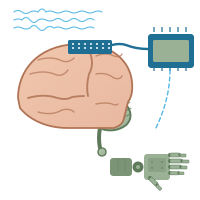
Brain computer interfaces & spinal cord
Implantable brain computer interfaces aimed at restoring movement after spinal cord injury; intraoperative spinal recordings during spinal cord stimulator implant; closed-loop neuromodulation for chronic pain. Gifts fund custom electrode arrays, software, and translational pilot work.
Research →Other ways to support the lab.
Philanthropic giving is one of several ways to help. Each of the others matters in its own way.
Take part in a study
Patients scheduled for surgery and healthy volunteers help the lab answer questions that no other approach can. The participation page explains what's involved, how consent works, and how to inquire.
Research participation →Share the lab's work
Tell family, friends, and your own physician about what we do. The biggest barrier to advanced neurosurgical care is often that patients and families don't know it exists. Our patient information page is written to be shared.
For Patients →Protect federal neuroscience funding
The NIH and especially the National Institute of Neurological Disorders and Stroke (NINDS) underwrite the basic research that this lab and others build on. Sustained federal neuroscience funding helps every neuroscience lab in the country.
NINDS →Follow the lab
Updates on new papers, talks, and lab milestones — on @iahncajigas on X, @iahncajigas on Instagram, and the lab's news page.
Lab news →Patients whose stories anchor the lab's research.
Four patients, each contributing to a different part of the lab's program — surgical care for movement disorders, intraoperative research that uncovers how the brain controls movement, and translational work on brain computer interfaces. All four have been publicly profiled in the linked sources. These are not solicited testimonials; their experiences continue to shape the lab's research direction.
Jim · DBS for essential tremor
Penn Medicine profiled Jim, who turned to the Penn Neurosurgery functional and stereotactic team for severe essential tremor. The piece walks through deep brain stimulation as the standard of care for surgical management of essential tremor — FDA-approved since 1997 — and explains why DBS was chosen for its versatility and ability to treat both hands simultaneously.
Read Jim's story on Penn Medicine →Joe · MRgFUS for essential tremor
Penn Medicine followed Joe, who had been living with essential tremor for 17 years. As his medications lost effectiveness, he consulted with the Penn Neurosurgery team and underwent MR-guided focused ultrasound — an incision-less, FDA-approved procedure that uses precisely targeted sound waves to treat the brain region driving the tremor. The piece describes how the procedure restored a passion he thought he had lost.
Read Joe's story on Penn Medicine →Gail Martin · awake-brain research participation
Penn Medicine profiled Gail Martin, who participated in the lab's intraoperative neurophysiology studies during awake deep brain stimulation surgery. Her contribution helps the lab characterize how microscale electrical activity in the brain results in precise movement control — the basic-science foundation that future neuromodulation and brain computer interface work depends on.
Read about the lab's brain-research program →German Aldana Zuniga · BCI after spinal cord injury
Penn Medicine profiled German Aldana Zuniga, a young patient living with a complete (ASIA A) spinal cord injury at the C5 level. Through years of participation he has contributed to foundational work on implantable brain computer interfaces — published across Brain Communications (2021), Frontiers in Neuroscience (2023), and the Journal of Neural Engineering (2025) — research that aims to restore function for people living with paralysis.
Read German's story on Penn Medicine →Larger gifts, endowments, and planned giving.
For named funds, endowments, IRA qualified charitable distributions, employer matching, or other forms of planned giving, the lab works with Penn Medicine Development.
Sheryl Garton · Penn Medicine Development
[email protected]
For a direct conversation about how a gift would be used in the lab's work, you can also email Iahn directly at [email protected].
Thank you.
Whichever way you choose to engage — a gift, sharing your story, taking part in a study, or simply telling someone who might benefit — every form of support is what keeps this work moving. The patients we treat and the families we work with are the reason the lab exists.