


Surgery for drug-resistant epilepsy.
Epilepsy: seizures that haven't fully responded to two or more medications.
Who we see
If you have seizures that haven't fully responded to medications, you may be a candidate for a surgical evaluation. The first step is almost never surgery — it's a careful workup with the team at the Penn Comprehensive Epilepsy Center to find out where in the brain your seizures are starting and decide which option fits best. Some patients are best served by removing or ablating a small area; others are better served by a device that delivers stimulation. We offer all of these.
- Drug-resistant epilepsy — seizures that haven't fully responded to two or more medications.
- Focal seizures — seizures that start in a specific part of the brain.
- Mesial temporal lobe epilepsy with hippocampal sclerosis — the most common form of focal epilepsy in adults.
- Lesional epilepsy — seizures from a tumor, cortical dysplasia, or cavernoma.
- Hypothalamic hamartoma — a rare deep-brain lesion that causes seizures, treatable with LITT.
- Bilateral or eloquent-cortex seizure foci — when seizures come from both sides of the brain or from areas that can't safely be removed.
Procedures we offer
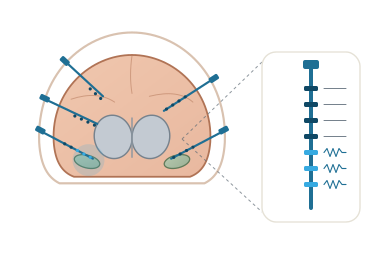
- Stereo-EEG (SEEG) monitoring — a short hospital stay where thin recording electrodes are placed in specific deep parts of the brain to track your seizures and pinpoint where they start. This is the diagnostic step that guides which treatment comes next.
- Anterior temporal lobectomy / selective amygdalohippocampectomy — open surgery to remove the small area where seizures start. The selective version preserves more surrounding brain tissue when only the deep mesial structures are involved. In a trial of 80 people with temporal lobe epilepsy, 58% of those who had anterior temporal lobectomy were free of seizures that affect awareness at one year, compared with 8% of those who stayed on medication alone. Wiebe et al., N Engl J Med 2001. Your team will discuss the numbers that apply to your specific situation.
- Lesionectomy — surgical removal of a tumor, cortical dysplasia, or cavernoma that's causing seizures.
- Laser interstitial thermal therapy (LITT) — a thin laser fiber is guided through a small skull opening to gently heat and stop the small area of brain tissue causing seizures. Used for mesial temporal lobe epilepsy (a procedure called SLAH, short for stereotactic laser amygdalohippocampotomy — laser treatment of the two deep structures where these seizures usually start) and for hypothalamic hamartomas. Usually a 1–2 day hospital stay; better cognitive recovery than open resection in many cases.
- Vagus nerve stimulation (VNS) — a small pacemaker-like device in the chest connected to a wire wrapped around a nerve in the neck. Adjunctive (added on top of medications); aim is reducing seizure frequency rather than seizure-freedom.
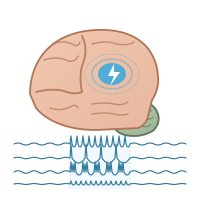
- Responsive neurostimulation (RNS, NeuroPace) — a small device implanted in the skull with one or two leads placed at the seizure focus. The device continually monitors your brain activity and delivers a brief, imperceptible stimulation when it detects abnormal patterns — often before a seizure becomes noticeable. Useful when seizures come from two foci, both sides of the brain, or from areas that can't safely be removed. In a nine-year study of 230 patients, seizures fell by a median of 75%, and about one patient in five had at least a full year with no seizures. Nair et al., Neurology 2020.
- Deep brain stimulation of the anterior thalamus (DBS-ANT) — bilateral DBS in the anterior thalamic nucleus to reduce focal seizure frequency. FDA-approved in 2018 based on the SANTE trial (Stimulation of the Anterior Nucleus of Thalamus for Epilepsy). At five years, seizures had fallen by a median of 69%, and about two-thirds of people had at least half as many seizures as before. Risks are part of the conversation in clinic before you decide. Salanova et al., Neurology 2015.
Risk and complication profiles for each of these procedures are part of the in-person discussion in clinic. They depend on your individual anatomy, medical history, and goals, and we walk through them with you before any procedure is recommended.
Before any procedure
- Epilepsy: high-resolution MRI, video-EEG monitoring (an inpatient stay to record seizures), neuropsychology testing, and sometimes PET or SPECT imaging. Your case is reviewed at the multidisciplinary epilepsy surgery conference. Some patients also need stereo-EEG (SEEG) as a separate diagnostic step before any treatment is decided.
A common question
What's recovery like after laser ablation (LITT) for epilepsy?
Most people stay in the hospital for one or two nights after LITT, then go home. The incision is small (a few millimeters). Most patients return to light activities within a week or two. Seizure outcomes are followed for at least a year. Your epilepsy team will discuss what to expect for your specific situation.
Where you’ll be seen
Most patients are first seen at Pennsylvania Hospital in Center City Philadelphia. A second clinic in Lancaster is available for patients in central Pennsylvania.
Penn Neurosurgery — Pennsylvania Hospital
801 Spruce Street
Philadelphia, PA 19107
Phone: 215-829-6700
Get directions on Google Maps →LG Health Physicians Neurology — Harrisburg Pike
2150 Harrisburg Pike
Lancaster, PA 17601
Phone: 717-396-9167
Get directions on Google Maps →Appointments and second opinions
Most patients arrive with a referral from a neurologist, primary-care physician, or epileptologist. A referral is not strictly required, but it lets your doctor send your imaging, notes, and medication list ahead of the visit, which makes the consultation more useful. To request an appointment, call 800-789-7366.