


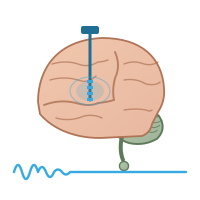
Surgery for essential tremor.
Essential tremor: when medications have stopped controlling the shaking.
Who we see
If your hands shake, your body stiffens, you have unwanted movements, or your medications have stopped working, surgery is sometimes an option. We don’t offer surgery as a first step — we work with the neurologists at the Penn Movement Disorders Center to make sure it’s the right next step for you. The right operation depends on the condition, the symptoms that bother you most, and what you can tolerate.
Four ways to treat severe tremor: at a glance.
For essential tremor, and for tremor-predominant Parkinson's disease, several surgical options exist. They share one goal — reaching the same small target deep in the brain (the VIM, a nucleus in the lateral thalamus) — but differ in how they get there: how invasive it is, how fast it works, whether it can be adjusted later, and which patients it suits. The table below is a starting point for the conversation, not a decision. The right choice depends on your specific situation, and we work through it with you in clinic.
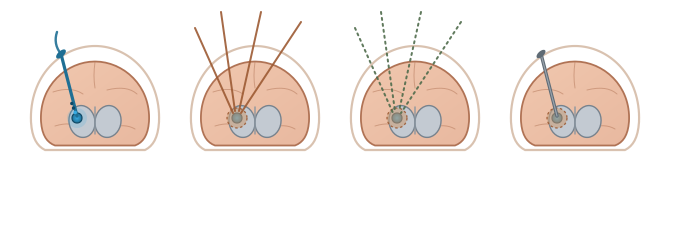
| Deep brain stimulation (DBS) | MR-guided focused ultrasound (MRgFUS) | Stereotactic radiosurgery (Gamma Knife) | Laser thalamotomy (LITT) | |
|---|---|---|---|---|
| What we do | Place a thin wire into the VIM area of the thalamus and connect it to a small pacemaker-like device under the skin. | Use focused sound waves through the skull to make a small lesion in the same brain target. No incision, no implant. | Use focused radiation through a fitted frame to make a small lesion in the same brain target. No incision, no implant. | Pass a thin laser fiber through a few-millimeter skull opening to the same brain target and, watched in real time on MRI, use heat to make a small lesion. No permanent implant. |
| Incision and hardware | Yes. Small scalp incisions and a chest incision for the device. | No incision. No implant. | No incision. No implant. | A small scalp incision and a few-millimeter skull opening. No permanent implant. |
| Anesthesia | Often awake for the test portion (so we can confirm the lead is in the right spot), then asleep for the device implant. | Awake throughout, in the MRI scanner. | Awake throughout. The frame is placed under local anesthesia. | Asleep (general anesthesia). |
| Hospital stay | One to two nights. | Same day. Most patients go home that evening. | Same day. Most patients go home that evening. | One to two nights. |
| One side or both? | Both sides can be treated, in the same operation or staged. | Approved for staged bilateral treatment, with the second side at least nine months after the first (FDA, 2022). | Usually one side only. Bilateral Gamma Knife thalamotomy is rarely offered. | One site at a time. |
| When does the benefit appear? | Immediately on the operating table when the lead is tested, then refined over the first six months as the device is programmed. | Immediately, on the table, in the MRI scanner. | Gradually, over three to six months. | Immediately, once the lesion is made. No programming needed. |
| Can it be adjusted later? | Yes. Settings are changed in clinic over time, and can be fine-tuned as your tremor changes. | No. The lesion is permanent. | No. The lesion is permanent. | No. The lesion is permanent. |
| Long-term considerations | Battery replacement every several years, and ongoing programming visits. Some patients see a gradual loss of tremor benefit over years (called habituation), which can sometimes be managed by reprogramming. | A single permanent treatment. Some patients see a partial return of tremor over years. | A single permanent treatment. Less long-term data than DBS or MRgFUS. | A single permanent treatment. As a newer image-guided approach, LITT has less long-term tremor-outcome data than radiofrequency (RF) thalamotomy, the original lesioning method. |
| If you take blood thinners | Blood thinners must be held before surgery. May not be appropriate if they cannot be safely held. | Often suitable, since there is no incision. | Often suitable, since there is no incision. | Must be held before the procedure, since it involves a scalp incision and a small skull opening. |
| FDA approval for essential tremor | 1997 (DBS of the VIM thalamus). | 2016 (unilateral). 2022 (staged bilateral, second side at nine months or later). | Used as an alternative when DBS and MRgFUS are not feasible. Performed under the broader FDA clearance for stereotactic radiosurgery. | Offered in select cases when MRgFUS is not a good fit (for example, skull anatomy). Performed under the FDA clearance for laser ablation of brain tissue. |
Radiofrequency (RF) thalamotomy, the original lesional approach to tremor, is not currently offered at Penn. In modern practice it has been largely replaced by MRgFUS, Gamma Knife, and LITT, which can produce similar tremor benefit using less invasive or more precisely controlled approaches.
Risk and complication profiles for each of these procedures are part of the in-person discussion in clinic. They depend on your individual anatomy, medical history, and goals, and we walk through them with you before any procedure is recommended.
Patient stories
Before any procedure
- Movement disorders: updated brain MRI, neuropsychology testing, and (for Parkinson's) sometimes a levodopa challenge, which measures how much of your symptom improves with your usual Parkinson's medication. Your case is then discussed at a multidisciplinary movement disorders conference, and we work through which procedure (DBS, MRgFUS, Gamma Knife, or LITT) fits your goals.
A common question
Will I be awake during deep brain stimulation surgery?
Sometimes, yes. For Parkinson's disease and essential tremor, the test portion of DBS is often done with you awake but very comfortable, because we ask you to do small tasks (tap your fingers, count) so we can confirm we have the lead in the right spot. You won't feel pain — only the brief setup is uncomfortable. The team will walk you through every step.
Where you’ll be seen
Most patients are first seen at Pennsylvania Hospital in Center City Philadelphia. A second clinic in Lancaster is available for patients in central Pennsylvania.
Penn Neurosurgery — Pennsylvania Hospital
801 Spruce Street
Philadelphia, PA 19107
Phone: 215-829-6700
Get directions on Google Maps →LG Health Physicians Neurology — Harrisburg Pike
2150 Harrisburg Pike
Lancaster, PA 17601
Phone: 717-396-9167
Get directions on Google Maps →Appointments and second opinions
Most patients arrive with a referral from a neurologist, primary-care physician, or epileptologist. A referral is not strictly required, but it lets your doctor send your imaging, notes, and medication list ahead of the visit, which makes the consultation more useful. To request an appointment, call 800-789-7366.