


Stroke: arm and hand recovery.
If you had an ischemic stroke six or more months ago and your arm or hand still hasn't fully recovered, paired vagus nerve stimulation (paired VNS) may help. It combines a small implanted device with intensive rehabilitation to help your brain rebuild the connections that move your arm — even years after the stroke.
Who is a candidate
- Chronic ischemic stroke — the stroke happened at least 6 months ago. Many patients in the original trial were 1 to 3 years out.
- Moderate-to-severe arm weakness that hasn't fully recovered with standard rehabilitation alone.
- Some preserved arm and hand movement — you can move your wrist, your thumb, and at least two fingers a little.
- Motivation to commit to rehab — the device works with therapy, not instead of it. The protocol is intensive (multiple sessions per week for about six weeks, plus daily practice at home).
What we offer
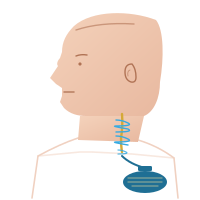
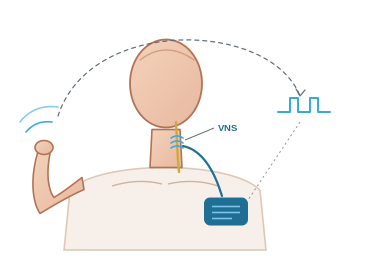
- Paired vagus nerve stimulation (paired VNS) — a small pacemaker-like generator sits on the left chest, just under the collarbone, and a thin wire is tunneled under the skin to gently wrap around the left vagus nerve in the neck. The surgery is short (about an hour) and most patients go home the same day or the next morning.
- Paired rehabilitation — during therapy sessions, your therapist triggers a brief, painless stimulation each time you successfully attempt a movement. The stimulation pairs with the action and helps your brain reinforce the pathway. After the in-clinic block, you continue at home using a magnet you wave over the device while practicing daily activities.
- Standard stroke rehabilitation — physical therapy, occupational therapy, and the full multidisciplinary stroke team at the Penn Comprehensive Stroke Center.
Paired VNS was FDA-approved in 2021 based on the VNS-REHAB pivotal trial (Dawson et al., Lancet 2021): a randomized, triple-blind, sham-controlled trial of 108 patients with chronic ischemic stroke and moderate-to-severe arm impairment. Patients who received paired VNS plus rehabilitation showed about twice the improvement in arm function as patients who received the same intensive rehabilitation alone. Most participants were 1–3 years post-stroke at enrollment.
Risk and complication profiles for each of these procedures are part of the in-person discussion in clinic. They depend on your individual anatomy, medical history, and goals, and we walk through them with you before any procedure is recommended.
Before any procedure
The first visit is a multidisciplinary evaluation with neurosurgery, stroke neurology, and rehabilitation medicine to confirm that you're a good candidate.
- Post-stroke arm recovery: review of your stroke imaging, a current functional assessment of arm strength and movement, confirmation that you are within the eligible window after stroke, and coordination with your stroke neurologist and rehabilitation team.
Common questions
How long after my stroke can I be considered for paired VNS?
The FDA-approved indication is for ischemic stroke at least six months in the past. In the pivotal trial, the average time since stroke was three years, and patients up to ten or more years out were enrolled — meaning recovery is still possible long after most rehabilitation programs end. The earliest you'd be eligible is around 6 months; there is no fixed upper limit, but we evaluate each patient individually.
How is paired VNS different from regular stroke rehab?
Standard rehabilitation works on its own, and many patients see meaningful improvement with it alone. Paired VNS is added on top of high-intensity rehabilitation for patients whose arm function has plateaued and is still moderate-to-severely impaired. The device delivers a brief stimulation paired with each movement attempt, which appears to enhance the brain's ability to relearn the motor task. In the pivotal trial, patients who got paired VNS plus rehab improved about twice as much as patients who got the same intensive rehab without the device.
Where you’ll be seen
Most patients are first seen at Pennsylvania Hospital in Center City Philadelphia. A second clinic in Lancaster is available for patients in central Pennsylvania.
Penn Neurosurgery — Pennsylvania Hospital
801 Spruce Street
Philadelphia, PA 19107
Phone: 215-829-6700
Get directions on Google Maps →LG Health Physicians Neurology — Harrisburg Pike
2150 Harrisburg Pike
Lancaster, PA 17601
Phone: 717-396-9167
Get directions on Google Maps →Appointments and second opinions
Most patients arrive with a referral from a neurologist, primary-care physician, or epileptologist. A referral is not strictly required, but it lets your doctor send your imaging, notes, and medication list ahead of the visit, which makes the consultation more useful. To request an appointment, call 800-789-7366.